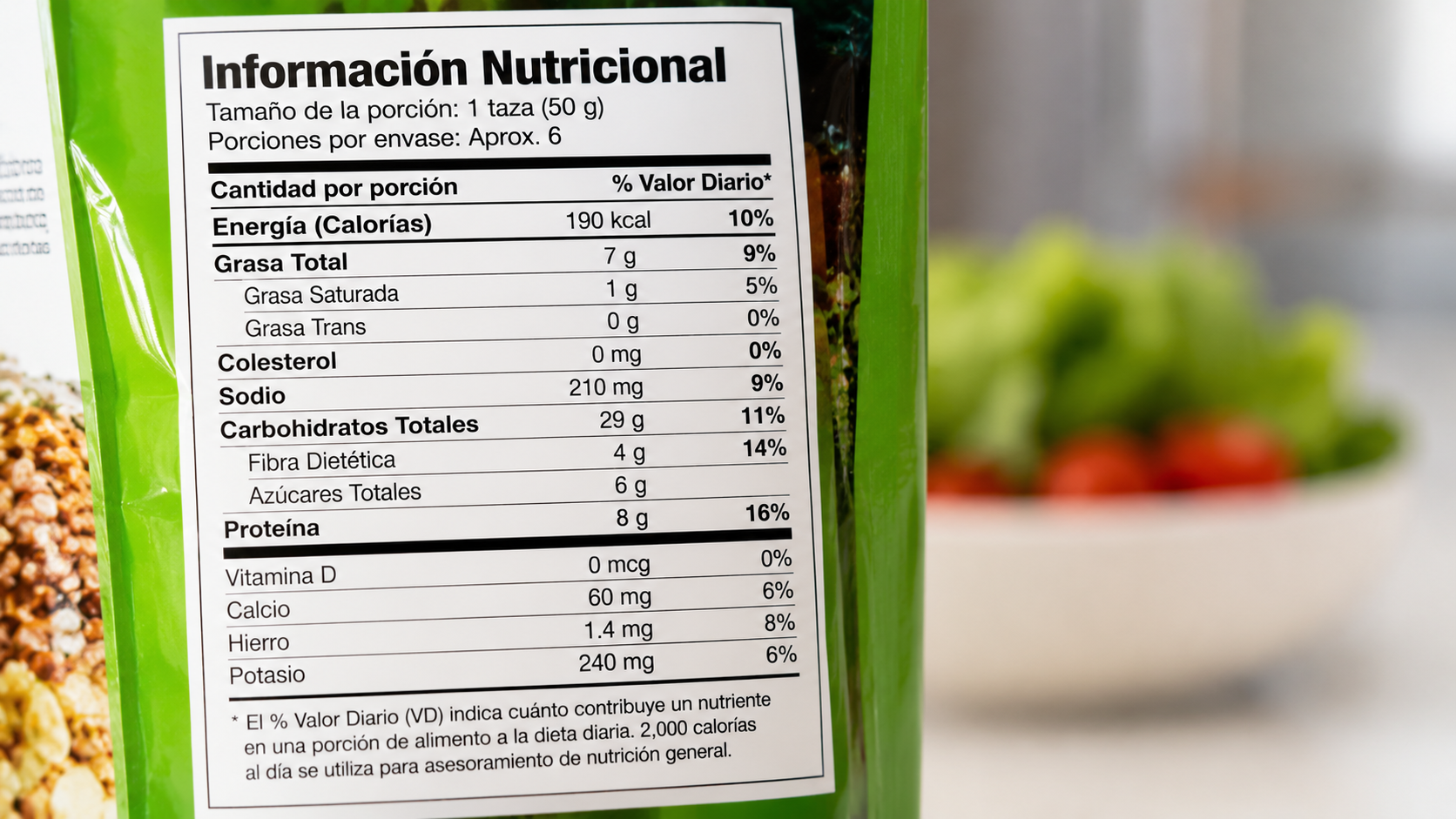
Why most people read labels wrong
Almost everyone looks at a product label and only checks the calories on the front. The problem is that number is usually calculated "per 100 g" or "per serving," and many brands choose ridiculously small serving sizes so the figure looks lower than what you'll actually eat.
Reading a nutrition label well doesn't require a nutrition degree. You just need to know what order to check the numbers in and which figures actually matter. Let's break it down.
💡 Golden rule: before looking at any number, always check the serving size first. Everything else on the label is calculated based on that amount, not the whole package.
The 5 numbers that actually matter
1. Serving size and servings per container
This is the most overlooked and most important figure. If a cookie package says "150 kcal per serving" but the package has 4 servings, eating the whole bag is 600 kcal, not 150. Always compare products using the "per 100 g" value, the only one that lets you compare fairly between brands.
2. Sugars — especially added sugars
The label usually shows "total carbohydrates, of which sugars." That figure includes both natural sugars (like those in fruit or milk) and sugars added by the manufacturer. Not all labels break this down clearly, so it's worth scanning the ingredient list to spot added sugar under its many aliases.
| Label name | What it actually is |
|---|---|
| Glucose-fructose syrup | Added sugar |
| Fruit juice concentrate | Added sugar disguised as "natural" |
| Dextrose, maltose, sucrose | Added sugar |
| Honey, agave syrup | Added sugar, even if it sounds "healthy" |
3. Fats: total, saturated and trans
Not all fats are equal. Total fat isn't the real concern; what's worth watching is the proportion of saturated fat, and above all avoiding any product listing "trans fats" or "partially hydrogenated oils" in the ingredients, since they're linked to a higher cardiovascular risk.
4. Protein
If your goal is to build muscle or lose fat while keeping it, this is one of the key numbers. We covered this in detail in how much protein you need per day based on your goal. When comparing two similar products (say, two yogurts), the one with more protein and less sugar is usually the better pick.
5. Fiber
Fiber is rarely highlighted, but it's an excellent indicator of nutritional quality. Bread, cereal or crackers with more than 3 g of fiber per 100 g can already be considered a good source. You can dig deeper into this topic in our guide to high-fiber foods.
How to read the ingredient list in 10 seconds
Ingredients are always listed from highest to lowest quantity. This means that if sugar appears among the first three ingredients of a product marketed as "healthy," it's probably not as healthy as it looks.
- The shorter the ingredient list, the less processed the product generally is.
- Be wary of very long lists with names you don't recognize (additives, emulsifiers, colorings).
- The same ingredient repeated under different names (sugar in 5 disguises) adds up more than it seems at first glance.
Marketing tricks to ignore
Phrases like "light," "natural," "no added sugar" or "source of protein" are regulated, but they don't always mean what you think:
- "Light" only means it has 30% less of something (usually fat or sugar) than the original version of the same product, not that it's low in calories in absolute terms.
- "No added sugar" doesn't mean "low sugar": it can still have plenty of natural sugar (juices, for example).
- "Source of protein" only requires 12% of calories to come from protein, a fairly low bar.
🎯 Practical tip: instead of trusting the front of the package, flip it over and always compare the "per 100 g" nutrition table before deciding.
Frequently asked questions
What does "%DV" mean on a label?
%DV stands for "Percent Daily Value," the percentage that food contributes to your estimated daily needs based on a 2,000 kcal diet. It's a general guide, but useful for a quick glance at whether a food contributes a lot or a little of a given nutrient.
Is the Nutri-Score reliable?
Nutri-Score-type systems are useful for comparing products within the same category, but they don't compare well across different categories (for example, olive oil can score worse than a diet soda because of its high calorie content, even though it's much healthier). Use it as support, not as your only reference.
Should I avoid all products with additives?
Not necessarily. Many approved additives are safe and serve a technological purpose (preservation, texture). The real issue is usually the amount of sugar, salt and low-quality fat, more than the presence of additives themselves.
Stop doing the math by hand
With Comeloia you just need to snap a photo of your food or the product: the app identifies calories and macros instantly, no label-decoding required.


Summary: what to remember
- Always check the serving size before looking at any other number.
- Compare products using the "per 100 g" value, not the per-serving one.
- Check the ingredient list: sugar has many different names.
- Prioritize products with more protein and fiber, and less sugar and saturated fat.
- Don't trust the marketing claims on the front of the package alone.
← Back to blog