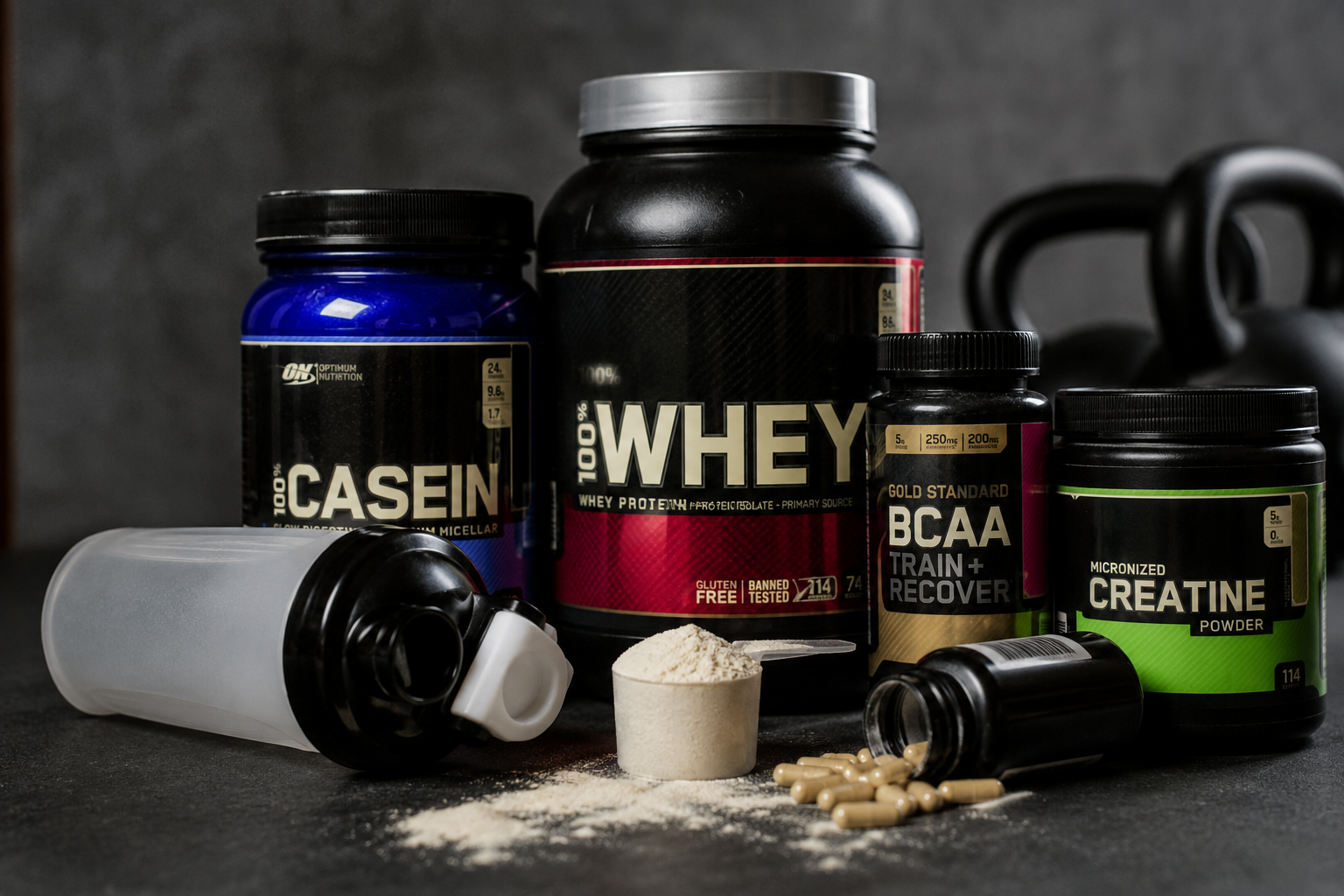
Why is there so much noise around supplements?
Walking into any sports nutrition store can be overwhelming: hundreds of products promise more energy, more muscle, less fat, or better focus. The truth is much simpler than the industry wants it to seem. The vast majority of these claims aren't backed by serious clinical trials, while a very small group of supplements has decades of consistent research behind it.
Before spending money on any product, it's worth remembering something basic: no supplement replaces a proper diet, training, or rest. What a supplement with good evidence can do is provide a marginal edge, close a specific nutritional gap, or make it easier to stick to your goals.
A supplement is never the foundation of good nutrition, it's a complement. The order of priorities is always the same: diet, training, rest, and only then, supplementation.
Creatine: the most studied supplement there is
If there's one supplement with near-universal scientific consensus, it's creatine monohydrate. A recent systematic review describes creatine as one of the most researched sports supplements, pointing to consistent improvements in muscle strength, lean mass gains, and training performance.
A 2025 meta-analysis combining data from dozens of controlled trials found that creatine supplementation, alongside resistance training, significantly improves both upper- and lower-body strength in adults under 50, with a somewhat larger effect in men than in women.
Creatine works by increasing phosphocreatine stores in muscle, allowing energy to be regenerated faster during short, intense efforts like strength sets or sprints. That's why its effect is greater in explosive, repeated activities than in single maximal-effort tests.
The typical evidence-based dose is 3 to 5 grams of creatine monohydrate per day, taken consistently. A loading phase isn't necessary to get long-term benefits.
Vitamin D: essential only if you're deficient
Vitamin D is probably the supplement with the biggest gap between what people believe and what the science actually says. It's not a "miracle vitamin," but correcting a real deficiency does have measurable benefits.
A clinical guideline published in JAMA in 2025 notes that, in adults aged 75 and older, a meta-analysis of 25 trials with nearly 50,000 participants linked supplementation with a reduction in all-cause mortality. A reduction in preeclampsia risk was also observed in pregnant women with low vitamin D levels, according to a 2025 meta-analysis published in Healthcare.
That said, it's not all good news: in people who already have adequate levels, adding more vitamin D doesn't provide clear extra benefits, and some meta-analyses find no effect on bone fractures in older adults. The scientific takeaway is clear: vitamin D helps those with a deficiency, not those who already have normal levels.
Before supplementing with vitamin D long-term, the best approach is to get your blood levels tested and adjust the dose with the help of a healthcare professional.
Omega-3: real benefits, but with caveats
Omega-3 fatty acids (EPA and DHA), found in oily fish and fish oil supplements, have one of the longest research histories in nutrition. A 2025 meta-analysis with over 176,000 participants assessed their effect on cardiovascular risk in people with established disease or high risk, confirming favorable effects on triglycerides.
Another dose-response analysis published in 2025 found that consuming more than 2 grams of omega-3 daily is associated with an almost linear reduction in triglycerides and non-HDL cholesterol. Still, not all studies agree: some long-term meta-analyses find no clear reduction in overall mortality at lower doses, which suggests that dose and clinical context matter a great deal.
In practice, if you already eat oily fish two or more times a week, you probably cover your basic needs. Supplementing makes more sense when dietary intake is low or triglycerides are elevated.
Protein powder: convenience, not magic
Protein powder (whey, casein, or plant-based) is simply a practical way to increase daily protein intake, especially useful when it's hard to hit your target through whole foods alone.
The evidence is consistent on one point: what determines muscle gain or maintenance is total daily protein intake and training stimulus, not the specific source of that protein. A protein shake doesn't build muscle on its own if total daily intake and training aren't in place.
| Supplement | Level of evidence | Typical evidence-based dose |
|---|---|---|
| Creatine monohydrate | Very high | 3-5 g/day |
| Vitamin D | High (if deficient) | 1,000-2,000 IU/day |
| Omega-3 (EPA/DHA) | Moderate-high | 1-2 g/day |
| Protein powder | High (as a protein source) | Based on daily protein target |
| Caffeine | High (performance) | 3-6 mg/kg before training |
Caffeine: the most accessible ergogenic aid
Caffeine is, alongside creatine, one of the supplements with the strongest evidence for athletic performance. It improves perceived effort, delays fatigue, and can increase strength and endurance when taken 30 to 60 minutes before training.
The magnitude of the benefit depends heavily on individual tolerance: people who consume caffeine daily usually need somewhat higher doses to feel the same effect as someone who isn't used to it.
Supplements with weak or insufficient evidence
Not everything sold in a supplement store has the same scientific backing. Here are some cases where the evidence is scarce, contradictory, or simply insufficient to justify widespread use:
- "Thermogenic" fat burners: the real effect on fat loss is usually minimal compared to a calorie deficit.
- Isolated BCAAs: if you already consume enough complete protein, they add little extra benefit.
- Collagen for muscle growth: the evidence is much stronger for skin and joints than for muscle mass gain.
- Generic "anti-fatigue" multivitamins: only useful if there's a real, diagnosed deficiency.
Track your nutrition with real data, not just supplements
With Comeloia you can analyze your meals with AI, log calories and macros in seconds, and find out whether you actually need to supplement anything.


Common mistakes when supplementing
1. Supplementing before fixing your baseline diet
Taking five different supplements while your daily eating is still disorganized is, in practice, putting a very small patch over a much bigger problem. The order of priorities matters.
2. Trusting marketing instead of evidence
Phrases like "exclusive formula" or "results in 7 days" aren't indicators of effectiveness. What matters is whether there are human clinical trials, at what dose, and with what results.
3. Ignoring interactions
Some supplements can interact with common medications, such as blood thinners or diabetes treatments. Checking with a healthcare professional before combining supplements is especially important if you take medication regularly.
Who should be more cautious?
- Pregnant or breastfeeding women.
- People with kidney or liver disease.
- People taking blood-thinning medication or diabetes medication.
- Teenagers who are still growing.
- People with a history of eating disorders.
In all of these cases, any supplementation should be discussed beforehand with a doctor or registered dietitian.
No supplement makes up for an unbalanced diet. The supplements with the strongest scientific evidence only make sense once you already have a solid foundation of nutrition, training, and rest.
Conclusion
Out of the entire universe of available supplements, very few pass the science filter with solid backing: creatine, caffeine, vitamin D (if deficient), omega-3, and protein as a practical tool. The rest usually provide, at best, a marginal effect, and at worst, just an unnecessary expense. The priority remains the same as always: eat well, train consistently, and rest enough.
← Back to blog